


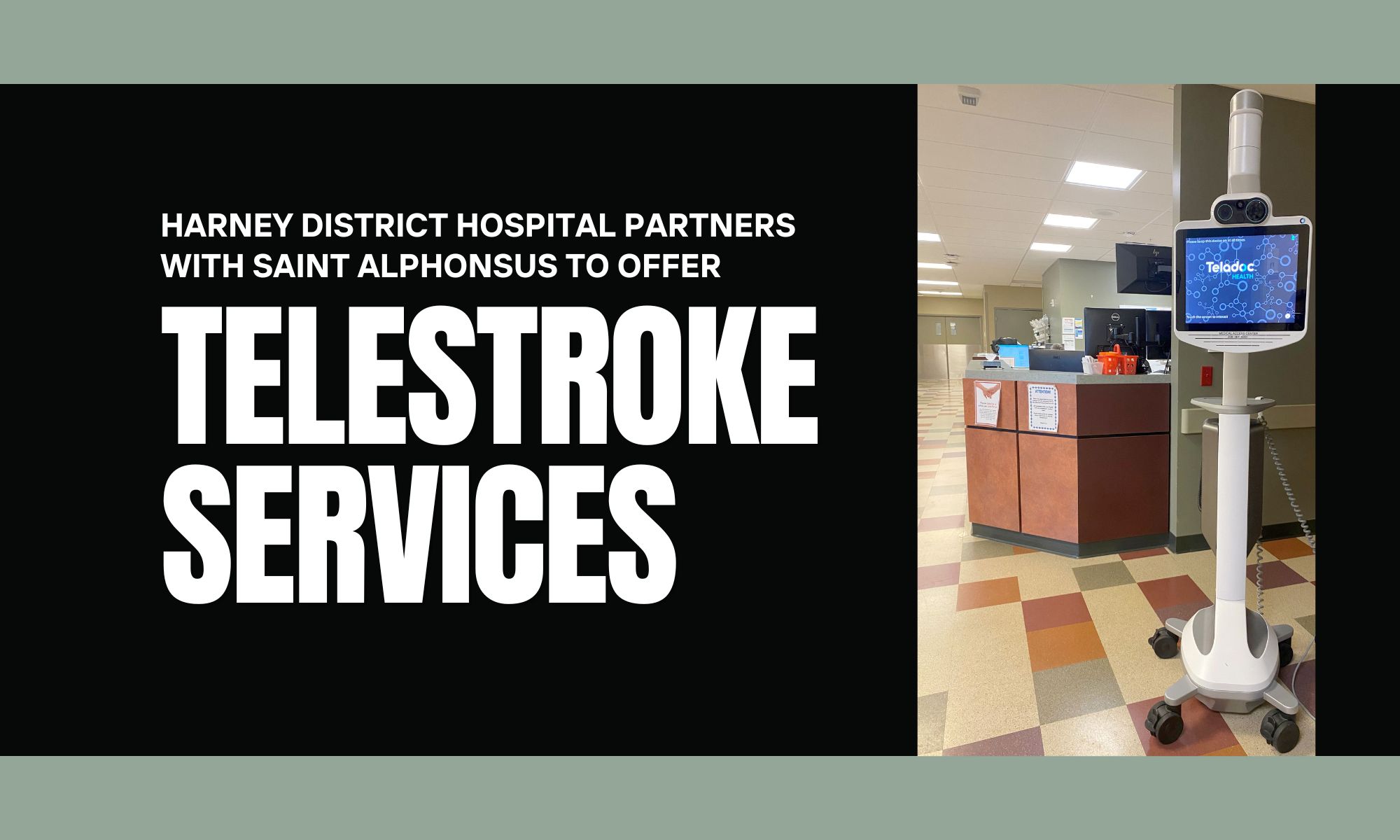
22 Apr Harney District Hospital partners with Saint Alphonsus to offer telestroke services
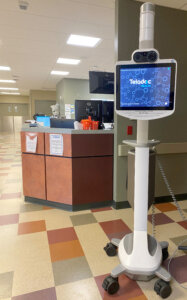
Harney District Hospital’s telestroke robot connects local healthcare providers with top-notch neurologists at Saint Alphonsus in Boise, Idaho to provide round-the-clock emergency care for local stroke patients.
On Feb. 2, Harney District Hospital (HDH) welcomed the newest member of its Emergency Department (ED) — a telestroke robot.
Due to our remote location, HDH faces unique challenges when it comes to caring for patients with stroke-like symptoms. That’s where telestroke (stroke telemedicine) comes in. HDH teamed up with top-notch neurologists (doctors who specialize in the diagnosis, treatment, and management of brain disorders) at Saint Alphonsus in Boise, Idaho to provide round-the-clock emergency care for local stroke patients.
How telestroke services work
If a patient is showing signs of a stroke, the local ED doctor will contact the on-call neurologist at Saint Alphonsus. Next, ED staff will wheel the robot to the foot of the patient’s bed. Using a program that’s similar to FaceTime, the robot will facilitate a video chat between the patient, ED providers, and neurologist. The robot will act as the neurologist’s eyes and ears, as they use the machine to thoroughly examine the patient in real time. This initial assessment can help the neurologist make lifesaving decisions when every second counts. (For example, the neurologist may be able to decide whether the patient should take blood-clot dissolving medication, which must be administered at the right time, under the right circumstances.) The robot’s camera can zoom in on the patient’s face and even see the size of their pupils. (Unequal pupil sizes or sudden/abnormal pupil constriction or dilation may indicate that the patient has had a stroke.) The onsite ED doctor and nurses will help the neurologist conduct the exam and position the robot. If needed, the ED doctor can use the robot’s handset telephone (or a regular phone) to have a one-on-one conversation with the neurologist to provide additional information about the patient’s care. To help aid in decision-making, the HDH Imaging Department will conduct a computerized tomography (CT) scan and share the results with the ED doctor and neurologist. (A CT scan is a type of imaging test that uses a series of X-rays and a computer to help healthcare providers detect diseases and injuries.)
The ED doctor will work with the neurologist to determine whether the patient should be transferred to Saint Alphonsus in Boise to receive more intensive, specialized neurological care. Saint Alphonsus automatically accepts stroke patients and will have a bed ready for them when they arrive — and the neurologist who determined the patient be transferred to Saint Alphonsus, will be the same neurologist who sees the patient upon arrival to ensure continuity of treatment.
Once the patient is safely in route to Boise, the robot will return to the alcove in the HDH ED to recharge after a hard day’s work. ED staff will ensure that the robot stays plugged in, so it can be continuously monitored by the Teladoc Health team. (Teladoc Health is a multinational company that provides the tools and technology needed to support telemedicine.) If the Teladoc team notices any issues with the robot, they’ll promptly alert HDH Nursing staff to begin troubleshooting. This 24/7 technical support helps ensure the robot is ready when time is of the essence.
Whenever possible, HDH will work with Saint Alphonsus to bring our patients home for follow-up care (transitional/ swing-bed care, rehabilitation, etc.). Fortunately, both hospitals use Epic to manage their electronic health records, which will help optimize care continuity.
Why immediate stroke treatment is critical
A stoke occurs when a blood vessel carrying oxygen and nutrients to the brain is either blocked by a clot (ischemic stroke) or ruptures (hemorrhagic stroke). When brain cells can’t receive the flow of blood (and oxygen) that they need to survive, they die. Brain cells (neurons) control our bodies by communicating through synapsis. When brain cells die, they stop sending messages to the parts of the body that they control. Without this essential information, these body parts “forget” how to function. The effect of a stroke can vary, depending on the location and the extent of damage to the brain tissue. However, one thing is certain. When it comes to strokes, “time is brain,” because millions of brain cells are lost every minute.
The Centers for Disease Control and Prevention (CDC) estimates that someone in the United States has a stroke every 40 seconds. That adds up to more than 795,000 Americans every year. Stroke is the nation’s No. 4 cause of death and leading cause of disability.
These harrowing statistics underscore the significance of telestroke services in our rural community.
“We’re excited for this opportunity to team up with Saint Alphonsus to provide state-of-the-art stroke care, right from the get-go,” HDH Chief Medical Officer Dr. Linda Selby said. “When every second counts, this partnership could be truly lifesaving!”
No Comments